

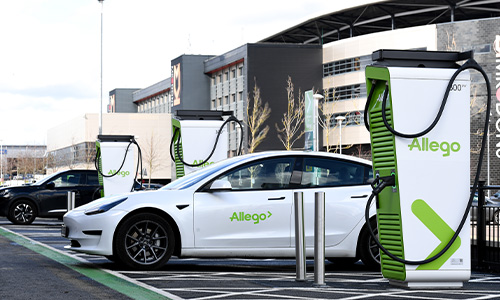


Charging shouldn’t slow you down. And Allego has made it as simple as… plugging in. No cards… no apps… plug in, your car does the rest.
Allego is the first in the world to launch the most secure version of Plug & Charge. It provides a cross-network solution for seamless charging and ensures tamper-proof charging sessions.
When you plug a compatible, Plug & Charge enabled EV into any of Allego’s over 5000 Fast and Ultra-fast charging points across Europe, the job is done. There is nothing else to do; the vehicle will take care of the rest. The vehicle and charging station exchange digital certificates to identify your account and automatically initiate charging. No additional manual steps are required. By removing bank cards, charging cards, RFIDs, and apps from the process, we empower drivers to focus on the journey, not the transaction.
One-time Setup Follow your in-vehicle and charging app steps to enable your EV for Plug & Charge.
Plug-In When you connect your EV, encrypted data flows between your vehicle and the charger.
Authenticate Mutual certificate-based authentication confirms your identity and billing credentials, and your session starts instantly. You can step away, and your charging progress is tracked in real time.
Allego Plug & Charge is available at 5000 Fast and Ultra-fast charging points in 16 European countries.
Effortless Access Plug in and charge; no RFID cards, bank cards, or mobile apps are required.
Industry-Leading Security Certificate-based authentication over encrypted communications (OCPP 2.0.1) ensures the most tamper-proof sessions possible.
True Interoperability Works seamlessly at Allego’s ultra-fast network and partner stations throughout Europe.
Plug & Charge. Open. Most Secure. Seamless.
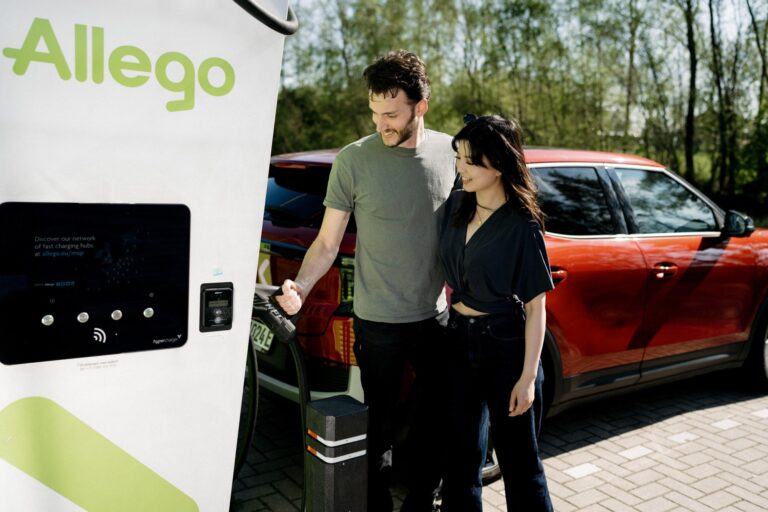
Allego has launched the industry’s most advanced charger-to-back-end protocol to grant the most secure experience. Plug & Charge is an ISO 15118-based authentication and payment method built by Allego on OCPP 2.0.1.
Mutual Transport Layer Security and certificate-based authentication guarantee that only authorized vehicles can charge, protecting drivers from billing errors or fraudulent access, resulting in transparent billing for the EV driver. Whether in the city, on the highway, or abroad, Plug & Charge delivers the same secure charging experience.
Frequently Asked Questions
- Allego chooses what Plug & Charge?
Allego has chosen to implement Plug & Charge on OCPP 2.0.1 with ISO 15118-2. - Why has Allego chosen Plug & Charge via OCPP 2.0.1
Implementing Plug and Charge on OCPP 2.0.1 offers EV drivers a more secure, seamless, and reliable charging experience. The enhanced security ensures their data is protected, while the native support for ISO 15118 enables automatic authentication, making charging as simple as plugging in. OCPP 2.0.1 also provides faster session initiation, better network interoperability, and improved real-time charging status and cost information. Additionally, it supports future technologies and allows for remote diagnostics, reducing downtime and ensuring charging stations are always up-to-date and reliable. Overall, it simplifies the charging process and enhances user satisfaction. - Is Plug & Charge the same as Autocharge?
Plug & Charge is a more secure, advanced, and standardized approach. At the same time, Autocharge is a simpler, less secure method that provides some of the same conveniences but without robust security features. Plug & Charge is based on open standards adopted across different networks, while Autocharge is a network-specific solution based on the car’s MAC address. - How is Plug & Charge activated, and which EV OEMs are compatible with Allego Plug & Charge?
Activation is typically done in car (via the vehicle UI) or OEM’s charging app (e.g., FordPass, My BMW app, Mercedes me, myAudi/Elli, Volvo On Call). Allego’s Hubject PKI network handles all certificate management and billing. For a full list of OEMs who support Plug & Charge, take a look here: https://www.hubject.com/ecosystem-overview. - What vehicles have been tested?
Testing was performed with several OEMs, including Ford, and more tests are ongoing. We will continue to conduct these tests as more OEMs launch EVs with plug-and-charge functionality.
If you have a specific vehicle in mind, it would be ideal to contact the manufacturer directly.
- Will Allego Plug & Charge automatically be enabled for all tested vehicles, or do I need a specific MSP contact?
Plug & Charge will not be automatically enabled for all vehicles. The vehicle must be compatible with Plug & Charge (ISO 15118 standard), and the user must have a specific MSP contract that supports it. You must ensure that your chosen MSP offers a Plug & Charge service compatible with your vehicle and charging network. You may need to configure the settings on your car or within the MSP app to enable Plug & Charge. - Will all chargers in Allego’s network support Plug & Charge?
All the HPCs that support OCPP 2.0.1 are enabled with Plug & Charge functionality. - If Plug & Charge is enabled, will it be the default solution automatically?
If Plug & Charge is enabled and set as the default payment method in the vehicle, it will typically initiate automatically when the car is plugged into a compatible charger. However, EV drivers can usually disable Plug & Charge in their vehicle settings or choose another payment method, such as using an RFID card or a mobile app. The exact process of selecting a different method may vary depending on the charging network or station and the vehicle’s user interface. - What happens if I plug in my vehicle and it automatically starts a Plug & Charge session, but I want to switch my payment method to a credit card?
When a Plug & Charge vehicle is connected to a compatible charger, it will automatically authenticate and start a charging session using the default Plug & Charge payment method linked to the car. Suppose you want to switch to a different payment method, such as a credit card. In that case, you must stop the current Plug & Charge session and initiate a new session using the desired payment method before plugging the connector into the vehicle. This process may vary depending on the charging network’s implementation or the station’s interface. - What happens if I want to switch payment methods inside Plug & Charge? Who do I need to contact?
Switching payment methods within Plug & Charge typically involves updating the payment method associated with the Plug & Charge contract. This requires contacting your Mobility Service Provider (MSP) or the provider that manages your Plug & Charge account, rather than the car manufacturer. Some vehicle infotainment systems may allow you to manage your payment methods directly, but most updates must be handled through the MSP’s app or website. - I have an MSP charging card from my Leasing company. How can I activate it for Allego Plug & Charge?
To activate Plug and Charge using an MSP charging card from your leasing company, you must contact your MSP (associated with your leasing company). Typically, you must register your vehicle and payment details with the MSP that supports it, associated with a particular vehicle brand and model. Some MSPs offer online portals or mobile apps where you can set up and link your charging card to enable Plug & Charge functionality. The process may vary depending on the MSP’s policies and user interface. - Will Plug & Charge also capture the idle fees Allego has on its chargers?
Yes, Plug & Charge will capture idle fees if these fees are part of the billing structure of the Mobility Service Provider (MSP) and the charging network. Idle fees are typically applied when a vehicle remains connected to the charger after reaching full charge. Since Plug & Charge handles the entire session’s authentication and payment, any additional fees, including idle fees, would be included in the final charge. - How long does it take to authenticate?
Authentication in Plug & Charge is typically fast, taking only a few seconds. It is handled directly between the vehicle and the charging station using encrypted communications, ensuring speed and security. - How long will it take from plugging into the charger till it starts?
From plugging the vehicle into the charger to starting the charging process, it usually takes a few seconds to a minute, depending on factors like the charging network, station response time, and vehicle communication. This time includes the authentication process and the initial communication handshake between the car and the charger. - Can you also use other payment methods with Plug & Charge enabled? For example, can you start an RFID session with Plug & Charge enabled in the car? If yes, how?
You can use other payment methods even if Plug & Charge is enabled. To do so, you should disable or deactivate Plug & Charge for that specific charging session. This might involve turning it off in your vehicle’s settings or using an alternative method, such as tapping an RFID card before plugging in the car. The exact procedure will depend on the charging station’s setup and the vehicle’s user interface. Some chargers may prioritize RFID cards or app-based payments if detected first, even when Plug & Charge is enabled. - Allego stands for interoperability. Is Plug & Charge not a limited authentication since you can only use an OEM mobility contract?
Plug & Charge is designed to be interoperable and standardized (ISO 15118). However, it relies on having an existing contract with an OEM or MSP that supports it. This can be seen as a limitation since users are restricted to using contracts compatible with their vehicle’s Plug & Charge capabilities. While this enhances convenience for drivers with such agreements, it does limit flexibility compared to other methods like RFID cards or credit card payments, which do not require such contracts.